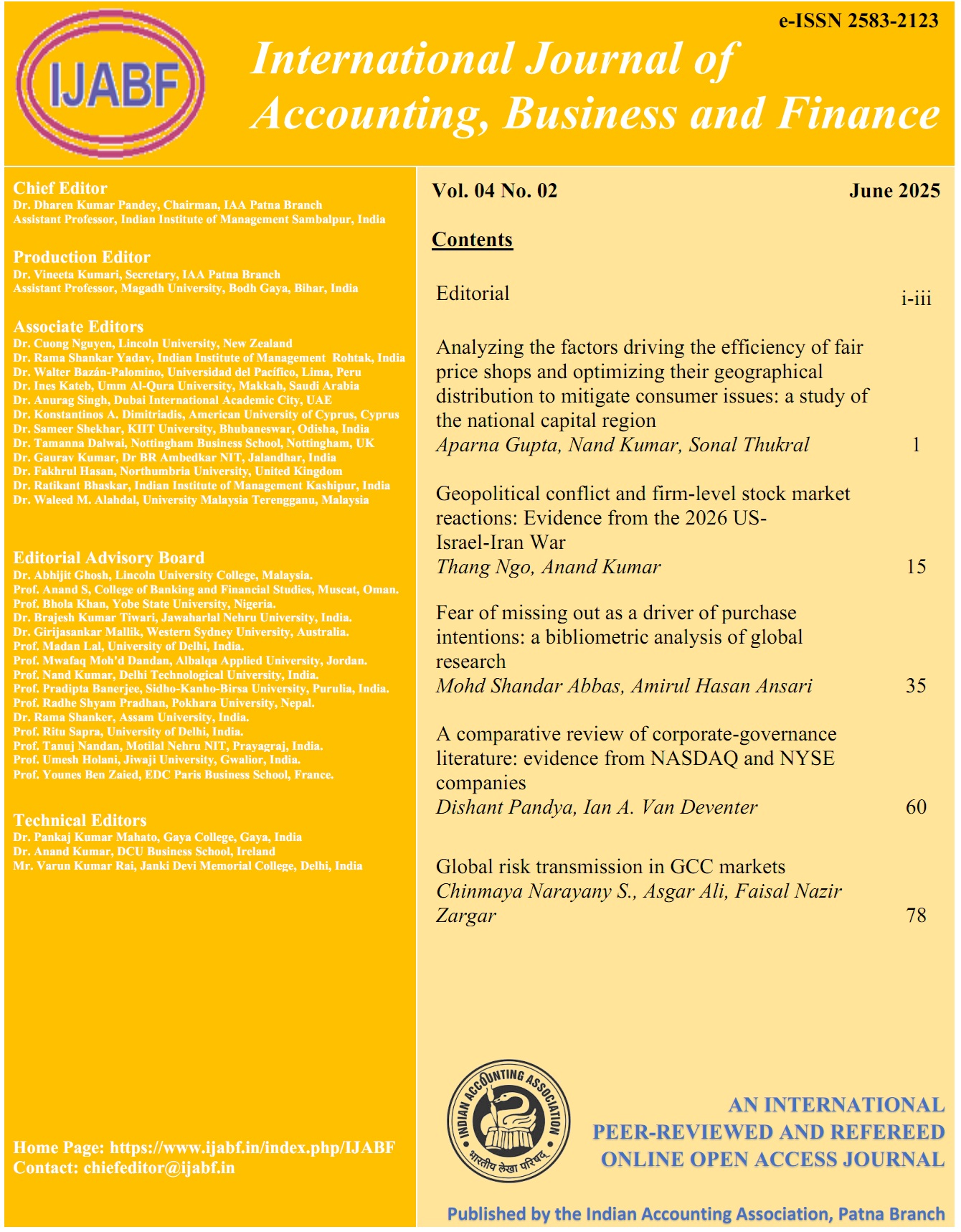
Fear of missing out as a driver of purchase intentions: a bibliometric analysis of global research
DOI:
https://doi.org/10.55429/ijabf.v4i2.281Keywords:
FOMO, Bibliometric, Purchase intentions, Psychology, Consumer behaviorAbstract
A psychological state that has emerged as an important construct to capture consumer behavior in the digital context is fear of missing out (FOMO). With the rise of social media, influencer campaigns, and scarcity-based content, FOMO is becoming increasingly prevalent and shaping consumer purchasing behavior. But the existing research is fragmented and dispersed across psychology, marketing, and behavioral science, with no overall appreciation of the field. Based on that, the current study undertakes a bibliometric analysis of global research on FOMO and purchase intention, drawing on 603 peer-reviewed papers from the Scopus and Web of Science databases. The performance analysis and science mapping techniques were carried out using Bibliometrix, focusing on keyword co-occurrence and thematic mapping. The results show that there was significantly increased research in the temporal frame post-2018, and prevailing research themes included anxiety, social media, addiction, and digital behavior. The study identifies areas for future research to converge FOMO with consumer behavior theory and practice, as well as directions for integrating theoretical developments in FOMO and digital consumer behavior.
References
Abdrabbo, T., Omeish, F., Kokash, F., Alghizzawi, M., & Alfaiza, S. A. (2025). The impact of scarcity and uniqueness on luxury products purchasing intention moderated by FoMO and social comparison. Discover Sustainability, 6(1), 857. https://doi.org/10.1007/s43621-025-01830-5 DOI: https://doi.org/10.1007/s43621-025-01830-5
Acedo, F. J., Barroso, C., Casanueva, C., & Galán, J. L. (2006). Co‐Authorship in Management and Organizational Studies: An Empirical and Network Analysis*. Journal of Management Studies, 43(5), 957–983. https://doi.org/10.1111/j.1467-6486.2006.00625.x DOI: https://doi.org/10.1111/j.1467-6486.2006.00625.x
Ajzen, I. (1991). The theory of planned behavior. Organizational Behavior and Human Decision Processes, 50(2), 179–211. https://doi.org/10.1016/0749-5978(91)90020-T DOI: https://doi.org/10.1016/0749-5978(91)90020-T
Appio, F. P., Cesaroni, F., & Di Minin, A. (2014). Visualizing the structure and bridges of the intellectual property management and strategy literature: a document co-citation analysis. Scientometrics, 101(1), 623–661. https://doi.org/10.1007/s11192-014-1329-0 DOI: https://doi.org/10.1007/s11192-014-1329-0
Aria, M., & Cuccurullo, C. (2017). bibliometrix : An R-tool for comprehensive science mapping analysis. Journal of Informetrics, 11(4), 959–975. https://doi.org/10.1016/j.joi.2017.08.007 DOI: https://doi.org/10.1016/j.joi.2017.08.007
Ben Arfi, W., Ben Nasr, I., Khvatova, T., & Ben Zaied, Y. (2021). Understanding acceptance of eHealthcare by IoT natives and IoT immigrants: An integrated model of UTAUT, perceived risk, and financial cost. Technological Forecasting and Social Change, 163, 120437. https://doi.org/10.1016/j.techfore.2020.120437 DOI: https://doi.org/10.1016/j.techfore.2020.120437
Beyens, I., Frison, E., & Eggermont, S. (2016). “I don’t want to miss a thing”: Adolescents’ fear of missing out and its relationship to adolescents’ social needs, Facebook use, and Facebook related stress. Computers in Human Behavior, 64, 1–8. https://doi.org/10.1016/j.chb.2016.05.083 DOI: https://doi.org/10.1016/j.chb.2016.05.083
Bhaskar, R., Hunjra, A. I., Bansal, S., & Pandey, D. K. (2022). Central Bank Digital Currencies: Agendas for future research. Research in International Business and Finance, 62, 101737. https://doi.org/10.1016/j.ribaf.2022.101737 DOI: https://doi.org/10.1016/j.ribaf.2022.101737
Bläse, R., Filser, M., Kraus, S., Puumalainen, K., & Moog, P. (2024). Non‐sustainable buying behavior: How the fear of missing out drives purchase intentions in the fast fashion industry. Business Strategy and the Environment, 33(2), 626–641. https://doi.org/10.1002/bse.3509 DOI: https://doi.org/10.1002/bse.3509
Cisneros, L., Ibanescu, M., Keen, C., Lobato-Calleros, O., & Niebla-Zatarain, J. (2018). Bibliometric study of family business succession between 1939 and 2017: mapping and analyzing authors’ networks. Scientometrics, 117(2), 919–951. https://doi.org/10.1007/s11192-018-2889-1 DOI: https://doi.org/10.1007/s11192-018-2889-1
Cobo, M. J., López-Herrera, A. G., Herrera-Viedma, E., & Herrera, F. (2011). An approach for detecting, quantifying, and visualizing the evolution of a research field: A practical application to the Fuzzy Sets Theory field. Journal of Informetrics, 5(1), 146–166. https://doi.org/10.1016/j.joi.2010.10.002 DOI: https://doi.org/10.1016/j.joi.2010.10.002
Dhir, A., Yossatorn, Y., Kaur, P., & Chen, S. (2018). Online social media fatigue and psychological wellbeing—A study of compulsive use, fear of missing out, fatigue, anxiety and depression. International Journal of Information Management, 40, 141–152. https://doi.org/10.1016/j.ijinfomgt.2018.01.012 DOI: https://doi.org/10.1016/j.ijinfomgt.2018.01.012
Dinh, T. C. T., Wang, M., & Lee, Y. (2023). How Does the Fear of Missing Out Moderate the Effect of Social Media Influencers on Their Followers’ Purchase Intention? Sage Open, 13(3). https://doi.org/10.1177/21582440231197259 DOI: https://doi.org/10.1177/21582440231197259
Donthu, N., Kumar, S., Mukherjee, D., Pandey, N., & Lim, W. M. (2021). How to conduct a bibliometric analysis: An overview and guidelines. Journal of Business Research, 133, 285–296. https://doi.org/10.1016/j.jbusres.2021.04.070 DOI: https://doi.org/10.1016/j.jbusres.2021.04.070
Elhai, J. D., Yang, H., & Montag, C. (2021). Fear of missing out (FOMO): overview, theoretical underpinnings, and literature review on relations with severity of negative affectivity and problematic technology use. Brazilian Journal of Psychiatry, 43(2), 203–209. https://doi.org/10.1590/1516-4446-2020-0870 DOI: https://doi.org/10.1590/1516-4446-2020-0870
Festinger, L. (1954). A Theory of Social Comparison Processes. Human Relations, 7(2), 117–140. https://doi.org/10.1177/001872675400700202 DOI: https://doi.org/10.1177/001872675400700202
Gao, B., Ji, Q., Zhang, T., & Xu, Y. (2023). Fear of missing out and phubbing behavior among undergraduates: Self-control as mediator, mindfulness as moderator. Social Behavior and Personality: An International Journal, 51(10), 1–12. https://doi.org/10.2224/sbp.12684 DOI: https://doi.org/10.2224/sbp.12684
Hansen, J. M., Saridakis, G., & Benson, V. (2018). Risk, trust, and the interaction of perceived ease of use and behavioral control in predicting consumers’ use of social media for transactions. Computers in Human Behavior, 80, 197–206. https://doi.org/10.1016/j.chb.2017.11.010 DOI: https://doi.org/10.1016/j.chb.2017.11.010
Hussain, S., Raza, A., Haider, A., Ishaq, M. I., & Talpur, Q. (2023). Fear of missing out and compulsive buying behavior: The moderating role of mindfulness. Journal of Retailing and Consumer Services, 75, 103512. https://doi.org/10.1016/j.jretconser.2023.103512 DOI: https://doi.org/10.1016/j.jretconser.2023.103512
Ismagilova, E., Slade, E. L., Rana, N. P., & Dwivedi, Y. K. (2020). The Effect of Electronic Word of Mouth Communications on Intention to Buy: A Meta-Analysis. Information Systems Frontiers, 22(5), 1203–1226. https://doi.org/10.1007/s10796-019-09924-y DOI: https://doi.org/10.1007/s10796-019-09924-y
Iyer, G. R., Blut, M., Xiao, S. H., & Grewal, D. (2020). Impulse buying: a meta-analytic review. Journal of the Academy of Marketing Science, 48(3), 384–404. https://doi.org/10.1007/s11747-019-00670-w DOI: https://doi.org/10.1007/s11747-019-00670-w
Jabeen, F., Tandon, A., Sithipolvanichgul, J., Srivastava, S., & Dhir, A. (2023). Social media-induced fear of missing out (FoMO) and social media fatigue: The role of narcissism, comparison and disclosure. Journal of Business Research, 159, 113693. https://doi.org/10.1016/j.jbusres.2023.113693 DOI: https://doi.org/10.1016/j.jbusres.2023.113693
Jelvehgaran Esfahani, H., Tavasoli, K., & Jabbarzadeh, A. (2019). Big data and social media: A scientometrics analysis. International Journal of Data and Network Science, 145–164. https://doi.org/10.5267/j.ijdns.2019.2.007 DOI: https://doi.org/10.5267/j.ijdns.2019.2.007
Kamboj, S., Sarmah, B., Gupta, S., & Dwivedi, Y. (2018). Examining branding co-creation in brand communities on social media: Applying the paradigm of Stimulus-Organism-Response. International Journal of Information Management, 39, 169–185. https://doi.org/10.1016/j.ijinfomgt.2017.12.001 DOI: https://doi.org/10.1016/j.ijinfomgt.2017.12.001
Kuss, D., & Griffiths, M. (2017). Social Networking Sites and Addiction: Ten Lessons Learned. International Journal of Environmental Research and Public Health, 14(3), 311. https://doi.org/10.3390/ijerph14030311 DOI: https://doi.org/10.3390/ijerph14030311
Linnenluecke, M. K., Marrone, M., & Singh, A. K. (2020). Conducting systematic literature reviews and bibliometric analyses. Australian Journal of Management, 45(2), 175–194. https://doi.org/10.1177/0312896219877678 DOI: https://doi.org/10.1177/0312896219877678
Liu, H., Liu, W., Yoganathan, V., & Osburg, V.-S. (2021). COVID-19 information overload and generation Z’s social media discontinuance intention during the pandemic lockdown. Technological Forecasting and Social Change, 166, 120600. https://doi.org/10.1016/j.techfore.2021.120600 DOI: https://doi.org/10.1016/j.techfore.2021.120600
Mert, M., & Tengilimoğlu, D. (2023). The mediating role of FoMO and the moderating role of narcissism in the impact of social exclusion on compulsive buying: a cross-cultural study. Psicologia: Reflexão e Crítica, 36(1), 33. https://doi.org/10.1186/s41155-023-00274-y DOI: https://doi.org/10.1186/s41155-023-00274-y
Mongeon, P., & Paul-Hus, A. (2016). The journal coverage of Web of Science and Scopus: a comparative analysis. Scientometrics, 106(1), 213–228. https://doi.org/10.1007/s11192-015-1765-5 DOI: https://doi.org/10.1007/s11192-015-1765-5
Petrescu, D. C., Vermeir, I., & Petrescu-Mag, R. M. (2019). Consumer Understanding of Food Quality, Healthiness, and Environmental Impact: A Cross-National Perspective. International Journal of Environmental Research and Public Health, 17(1), 169. https://doi.org/10.3390/ijerph17010169 DOI: https://doi.org/10.3390/ijerph17010169
Piwowar, H., Priem, J., Larivière, V., Alperin, J. P., Matthias, L., Norlander, B., Farley, A., West, J., & Haustein, S. (2018). The state of OA: a large-scale analysis of the prevalence and impact of Open Access articles. PeerJ, 6, e4375. https://doi.org/10.7717/peerj.4375 DOI: https://doi.org/10.7717/peerj.4375
Przybylski, A. K., Murayama, K., DeHaan, C. R., & Gladwell, V. (2013). Motivational, emotional, and behavioral correlates of fear of missing out. Computers in Human Behavior, 29(4), 1841–1848. https://doi.org/10.1016/j.chb.2013.02.014 DOI: https://doi.org/10.1016/j.chb.2013.02.014
Solt, M. van, Rixom, J., & Taylor, K. (2018). FOMO: How the Fear of Missing Out Drives Consumer Purchase Decisions. https://doi.org/10.20429/amtp.2018.41 DOI: https://doi.org/10.20429/amtp.2018.41
Tandon, A., Laato, S., Islam, N., & Dhir, A. (2025). Social comparisons at social networking sites: how social Media-induced fear of missing out and envy drive compulsive use. Internet Research, 35(2), 691–718. https://doi.org/10.1108/INTR-10-2022-0770 DOI: https://doi.org/10.1108/INTR-10-2022-0770
White, K., Habib, R., & Hardisty, D. J. (2019). How to SHIFT Consumer Behaviors to be More Sustainable: A Literature Review and Guiding Framework. Journal of Marketing, 83(3), 22–49. https://doi.org/10.1177/0022242919825649 DOI: https://doi.org/10.1177/0022242919825649
Wolniewicz, C. A., Tiamiyu, M. F., Weeks, J. W., & Elhai, J. D. (2018). Problematic smartphone use and relations with negative affect, fear of missing out, and fear of negative and positive evaluation. Psychiatry Research, 262, 618–623. https://doi.org/10.1016/j.psychres.2017.09.058 DOI: https://doi.org/10.1016/j.psychres.2017.09.058
Zupic, I., & Čater, T. (2015). Bibliometric Methods in Management and Organization. Organizational Research Methods, 18(3), 429–472. https://doi.org/10.1177/1094428114562629 DOI: https://doi.org/10.1177/1094428114562629
Downloads
Published
How to Cite
Issue
Section
License
Copyright (c) 2026 Mohd Shandar Abbas, Amirul Hasan Ansari

This work is licensed under a Creative Commons Attribution-NonCommercial 4.0 International License.
This is an open-access journal. Your article will be published open-access, but you will not have to pay an APC (article processing charge) - publication is free. Your article will be published with a Creative Commons CC BY-NC 4.0 user licence, which outlines how readers can reuse your work. The licence terms may be found at https://creativecommons.org/licenses/by-nc/4.0/.




Accepted 2026-05-31
Published 2026-06-06