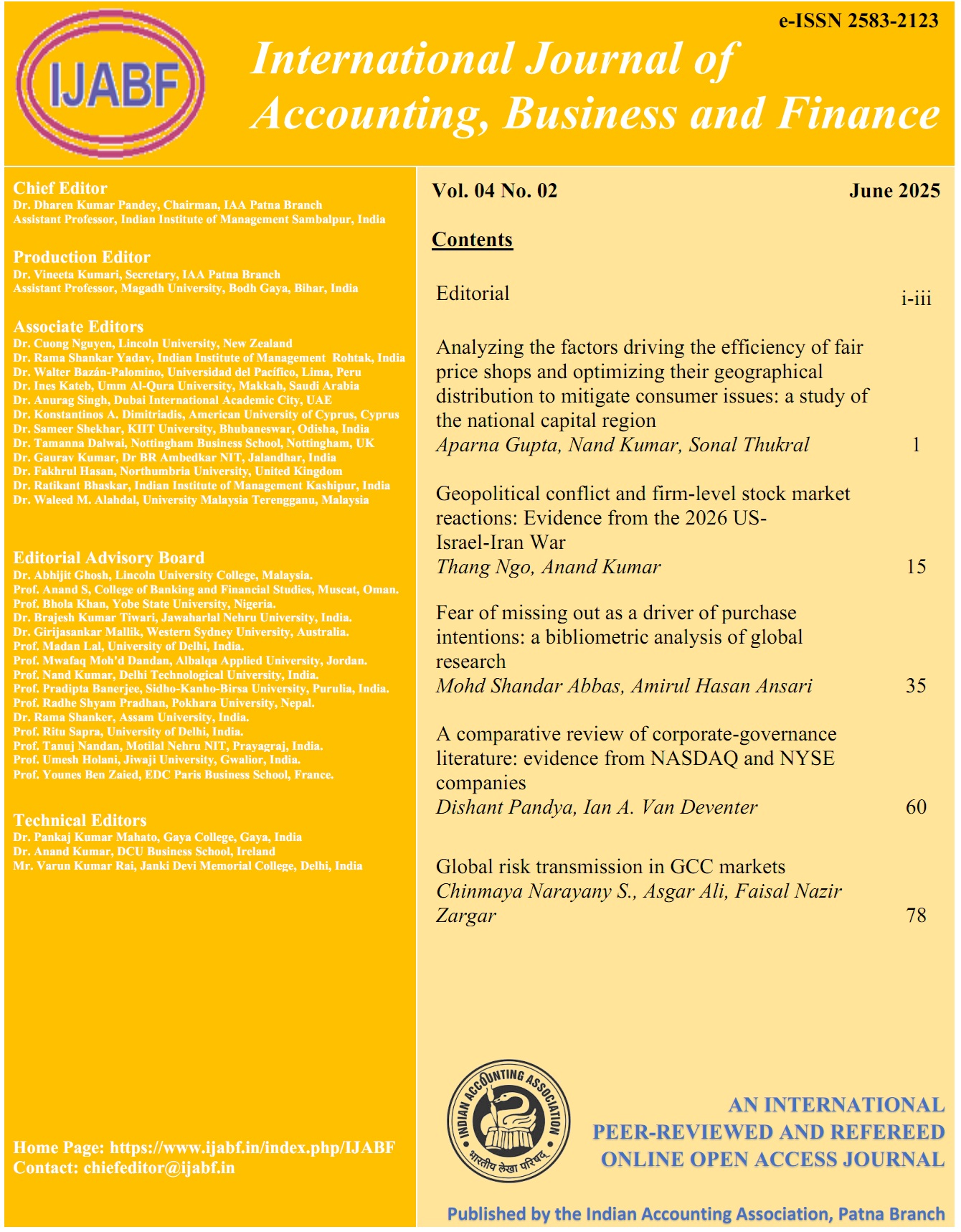
Geopolitical conflict and firm-level stock market reactions: evidence from the 2026 US-Israel-Iran war
DOI:
https://doi.org/10.55429/ijabf.v4i2.309Keywords:
Geopolitical risk, Israel-Iran war, Event study, US-Iran war, Oil price exposure, Emerging marketsAbstract
This study examines the impact of the 2026 US–Israel–Iran conflict on the Indian stock market using an event-study framework and a firm-level cross-sectional analysis. Using daily stock price data for 1,715 firms listed on the National Stock Exchange of India, we estimate abnormal returns around the outbreak of the conflict and analyze the determinants of cross-sectional variation in stock market reactions. The results show significant abnormal returns around the event date, indicating that the geopolitical shock was rapidly incorporated into equity prices. Cross-sectional regressions reveal that firms with greater sensitivity to market volatility experience significantly lower abnormal returns during the event and post-event windows, highlighting the role of uncertainty-driven risk premia. In contrast, oil price sensitivity does not significantly explain cross-sectional differences in stock market reactions. The findings suggest that financial market uncertainty is the primary channel through which the geopolitical conflict affected Indian equities. This study contributes to the firm-level evidence on geopolitical risk, highlighting financial uncertainty over oil channels, and examining 2026 US–Israel–Iran conflict in emerging markets.
References
Aggarwal, R., Akhigbe, A., & Mohanty, S. K. (2012). Oil price shocks and transportation firm asset prices. Energy Economics, 34(5), 1370–1379. https://doi.org/10.1016/j.eneco.2012.05.001 DOI: https://doi.org/10.1016/j.eneco.2012.05.001
Agoraki, M.-E. K., Kouretas, G. P., & Laopodis, N. T. (2022). Geopolitical risks, uncertainty, and stock market performance. Economic and Political Studies, 10(3), 253–265. https://doi.org/10.1080/20954816.2022.2095749 DOI: https://doi.org/10.1080/20954816.2022.2095749
Álamos, E. S. (2024). “Russia’s Special Military Operation in Ukraine”, The Effect of this Announcement on the Performance of Emerging Stock Markets and its Relationship with Economic Growth. A Case for Event Study. Journal of Globalization, Competitiveness and Governability, 18(3), 20–34. https://doi.org/10.58416/GCG.2024.V18.N3.01 DOI: https://doi.org/10.58416/GCG.2024.V18.N3.01
Baker, S. R., Bloom, N., & Davis, S. J. (2016). Measuring Economic Policy Uncertainty*. The Quarterly Journal of Economics, 131(4), 1593–1636. https://doi.org/10.1093/qje/qjw024 DOI: https://doi.org/10.1093/qje/qjw024
Basher, S. A., & Sadorsky, P. (2006). Oil price risk and emerging stock markets. Global Finance Journal, 17(2), 224–251. https://doi.org/10.1016/j.gfj.2006.04.001 DOI: https://doi.org/10.1016/j.gfj.2006.04.001
Bekaert, G., Ehrmann, M., Fratzscher, M., & Mehl, A. (2014). The Global Crisis and Equity Market Contagion. The Journal of Finance, 69(6), 2597–2649. https://doi.org/10.1111/jofi.12203 DOI: https://doi.org/10.1111/jofi.12203
Bekaert, G., Engstrom, E., & Xing, Y. (2009). Risk, uncertainty, and asset prices. Journal of Financial Economics, 91(1), 59–82. https://doi.org/10.1016/j.jfineco.2008.01.005 DOI: https://doi.org/10.1016/j.jfineco.2008.01.005
Bhattacharjee, A., Gaur, D., & Gupta, K. (2024). Russia–Ukraine war and the impact on Indian economy. Journal of Economic Studies, 51(4), 841–858. https://doi.org/10.1108/JES-03-2023-0136 DOI: https://doi.org/10.1108/JES-03-2023-0136
Bloom, N. (2009). The Impact of Uncertainty Shocks. Econometrica, 77(3), 623–685. https://doi.org/10.3982/ECTA6248 DOI: https://doi.org/10.3982/ECTA6248
Boubaker, S., Farag, H., & Nguyen, D. K. (2015). Short-term overreaction to specific events: Evidence from an emerging market. Research in International Business and Finance, 35, 153–165. https://doi.org/10.1016/j.ribaf.2014.10.002 DOI: https://doi.org/10.1016/j.ribaf.2014.10.002
Caldara, D., & Iacoviello, M. (2022). Measuring Geopolitical Risk. American Economic Review, 112(4), 1194–1225. https://doi.org/10.1257/aer.20191823 DOI: https://doi.org/10.1257/aer.20191823
Campbell, J. Y., Lo, A. W., & MacKinlay, A. C. (1997). The Econometrics of Financial Markets. Princeton University Press. https://doi.org/10.1515/9781400830213 DOI: https://doi.org/10.1515/9781400830213
Chan, K. F., & Marsh, T. (2021). Asset prices, midterm elections, and political uncertainty. Journal of Financial Economics, 141(1), 276–296. https://doi.org/10.1016/j.jfineco.2021.03.007 DOI: https://doi.org/10.1016/j.jfineco.2021.03.007
Chen, Z., Liang, C., & Umar, M. (2021). Is investor sentiment stronger than VIX and uncertainty indices in predicting energy volatility? Resources Policy, 74, 102391. https://doi.org/10.1016/j.resourpol.2021.102391 DOI: https://doi.org/10.1016/j.resourpol.2021.102391
Corrado, C. J. (1989). A nonparametric test for abnormal security-price performance in event studies. Journal of Financial Economics, 23(2), 385–395. https://doi.org/https://doi.org/10.1016/0304-405X(89)90064-0 DOI: https://doi.org/10.1016/0304-405X(89)90064-0
Fama, E. F. (1970). Efficient Capital Markets: A Review of Theory and Empirical Work. The Journal of Finance, 25(2), 383. https://doi.org/10.2307/2325486 DOI: https://doi.org/10.2307/2325486
Fernandez, V. (2007). Stock Market Turmoil: Worldwide Effects of Middle East Conflicts. Emerging Markets Finance & Trade, 43(3), 58–102. http://www.jstor.org/stable/27750551 DOI: https://doi.org/10.2753/REE1540-496X430304
Filis, G., Degiannakis, S., & Floros, C. (2011). Dynamic correlation between stock market and oil prices: The case of oil-importing and oil-exporting countries. International Review of Financial Analysis, 20(3), 152–164. https://doi.org/10.1016/j.irfa.2011.02.014 DOI: https://doi.org/10.1016/j.irfa.2011.02.014
Fiorillo, P., Meles, A., Pellegrino, L. R., & Verdoliva, V. (2024). Geopolitical risk and stock price crash risk: The mitigating role of ESG performance. International Review of Financial Analysis, 91, 102958. https://doi.org/10.1016/j.irfa.2023.102958 DOI: https://doi.org/10.1016/j.irfa.2023.102958
Forbes, K. J., & Rigobon, R. (2002). No Contagion, Only Interdependence: Measuring Stock Market Comovements. The Journal of Finance, 57(5), 2223–2261. https://doi.org/10.1111/0022-1082.00494 DOI: https://doi.org/10.1111/0022-1082.00494
Garzón, A. J., & Hierro, L. A. (2018). Fracking, wars and stock market crashes: The price of oil during the great recession. International Journal of Energy Economics and Policy, 8(2), 20–30. https://www.scopus.com/inward/record.uri?eid=2-s2.0-85044326218&partnerID=40&md5=17d215aa9a719ad4f7c534a197942a22
Goyal, P., & Soni, P. (2023). FTX fiasco and global equity markets: evidence from event study approach. Journal of Financial Economic Policy, 15(4/5), 396–407. https://doi.org/10.1108/JFEP-04-2023-0100 DOI: https://doi.org/10.1108/JFEP-04-2023-0100
Goyal, P., & Soni, P. (2024). Beyond borders: investigating the impact of the 2023 Israeli–Palestinian conflict on global equity markets. Journal of Economic Studies. https://doi.org/10.1108/JES-12-2023-0729 DOI: https://doi.org/10.1108/JES-12-2023-0729
Guenichi, H., Khalfaoui, H., & Chouaibi, N. (2021). The impact of own-country, USA and China’s economic policy uncertainty on stock market returns: Evidence from war, epidemic and financial crisis periods. International Journal of Sustainable Economy, 13(2), 126–149. https://doi.org/10.1504/IJSE.2021.114617 DOI: https://doi.org/10.1504/IJSE.2021.114618
Hanif, M., Hassan, M., Henchiri, B., & AlDaas, M. (2022). Impact of the COVID-19 pandemic on banking and financial sector stock returns. International Journal of Accounting, Business and Finance, 1(2), 19–35. https://doi.org/10.55429/ijabf.v1i2.72 DOI: https://doi.org/10.55429/ijabf.v1i2.72
Jha, K. K., & Katiyar, K. (2024). Impact of Russia-Ukraine war on Oil & Gas, Commodities and Metal Sector of Indian Economy. 2024 IEEE International Conference on Interdisciplinary Approaches in Technology and Management for Social Innovation, IATMSI 2024. https://doi.org/10.1109/IATMSI60426.2024.10503500
Katiyar, K., Gupta, T., & Jha, K. K. (2024). Impact of Russia-Ukraine War on Oil and Gas Sector of Indian Economy. In Smart Innovation, Systems and Technologies: 409 SIST. https://doi.org/10.1007/978-981-97-7094-6_6 DOI: https://doi.org/10.1007/978-981-97-7094-6_6
Khan, M. H., Ahmed, J., Mughal, M., & Khan, I. H. (2022). Oil price volatility and stock returns: Evidence from three oil-price wars. International Journal of Finance and Economics. https://doi.org/10.1002/ijfe.2588 DOI: https://doi.org/10.1002/ijfe.2588
Kilian, L. (2008). The Economic Effects of Energy Price Shocks. Journal of Economic Literature, 46(4), 871–909. https://doi.org/10.1257/jel.46.4.871 DOI: https://doi.org/10.1257/jel.46.4.871
Kilian, L., & Park, C. (2009). The impact of oil price shocks on the U.S. stock market. International Economic Review, 50(4), 1267–1287. https://doi.org/10.1111/j.1468-2354.2009.00568.x DOI: https://doi.org/10.1111/j.1468-2354.2009.00568.x
Kollias, C., Kyrtsou, C., & Papadamou, S. (2013). The effects of terrorism and war on the oil price-stock index relationship. Energy Economics, 40, 743–752. https://doi.org/10.1016/j.eneco.2013.09.006 DOI: https://doi.org/10.1016/j.eneco.2013.09.006
Kumar, R., & Moussa, F. (2025). The impact of US reciprocal tariff announcements on global stock markets: an event study analysis. International Journal of Accounting, Business and Finance, 4(1), 26–37. https://doi.org/10.55429/ijabf.v4i1.205 DOI: https://doi.org/10.55429/ijabf.v4i1.205
Kumari, V., Pandey, D. K., Kumar, S., & Xu, E. (2022). What do border disputes cost? Evidence from an emerging market. International Journal of Emerging Markets. https://doi.org/10.1108/IJOEM-06-2022-0918 DOI: https://doi.org/10.1108/IJOEM-06-2022-0918
Leigh, A., Wolfers, J., Zitzewitz, E., Benkard, L., Bulow, J., Bresnahan, T., Duncan, M., Henry, P., Karlan, D., Kremer, I., Lefgren, L., Levitt, S., Malmendier, U., Marti, A., Mcmillan, J., Oyer, P., Reuter, J., Skrzypacz, A., Stern, S., … Yu, S. (2003). What Do Financial Markets Think of War in Iraq? http://www.nber.org/papers/w9587 DOI: https://doi.org/10.3386/w9587
Marobhe, M. I., Kansheba, J. M., & Munim, Z. H. (2025). Geopolitical uncertainty and shipping stock returns: An event study of the Israel-Hamas conflict. Journal of Transport Geography, 123, 104122. https://doi.org/10.1016/j.jtrangeo.2025.104122 DOI: https://doi.org/10.1016/j.jtrangeo.2025.104122
Maurya, P. K., Bansal, R., & Mishra, A. K. (2023). Russia–Ukraine conflict and its impact on global inflation: an event study-based approach. Journal of Economic Studies. https://doi.org/10.1108/JES-01-2023-0003 DOI: https://doi.org/10.1108/JES-01-2023-0003
Miyajima, H., & Yafeh, Y. (2007). Japan’s banking crisis: An event-study perspective. Journal of Banking and Finance, 31(9), 2866–2885. https://doi.org/10.1016/j.jbankfin.2007.03.006 DOI: https://doi.org/10.1016/j.jbankfin.2007.03.006
Nathaniel, S. P., Adeleye, N., & Adedoyin, F. F. (2021). Natural Resource Abundance, Renewable Energy, and Ecological Footprint Linkage in MENA Countries. Studies of Applied Economics, 39(3). https://doi.org/10.25115/eea.v39i2.3927 DOI: https://doi.org/10.25115/eea.v39i2.3927
Paltrinieri, A., Perdichizzi, S., & Piserà, S. (2026). Safe havens or war hedges? Asset behavior during the 2026 escalation of the Iran conflict. Economics Letters, 113010. https://doi.org/10.1016/j.econlet.2026.113010 DOI: https://doi.org/10.1016/j.econlet.2026.113010
Pandey, D. K., Assaf, R., & Rai, V. K. (2023). Did the Indian stock market sail the Russia-Ukraine storm safely? The Journal of Economic Asymmetries, 28, e00319. https://doi.org/10.1016/j.jeca.2023.e00319 DOI: https://doi.org/10.1016/j.jeca.2023.e00319
Pandey, D. K., Lucey, B. M., & Kumar, S. (2023). Border Disputes, Conflicts, War, and Financial Markets Research: A Systematic Review. Research in International Business and Finance, 101972. https://doi.org/10.1016/j.ribaf.2023.101972 DOI: https://doi.org/10.1016/j.ribaf.2023.101972
Pástor, Ľ., & Veronesi, P. (2013). Political uncertainty and risk premia. Journal of Financial Economics, 110(3), 520–545. https://doi.org/10.1016/j.jfineco.2013.08.007 DOI: https://doi.org/10.1016/j.jfineco.2013.08.007
Ruiz Estrada, M. A., Park, D., Tahir, M., & Khan, A. (2020). Simulations of US-Iran war and its impact on global oil price behavior. Borsa Istanbul Review, 20(1), 1–12. https://doi.org/10.1016/J.BIR.2019.11.002 DOI: https://doi.org/10.1016/j.bir.2019.11.002
Saini, M., Yadav, M., & Aggarwal, V. (2024). Russia-Ukraine war: impacts on major stocks and oil markets. International Journal of Electronic Finance, 13(2), 216–255. https://doi.org/10.1504/IJEF.2024.137635 DOI: https://doi.org/10.1504/IJEF.2024.137635
Saini, M., Yadav, M., Aggarwal, V., & Kumar, M. (2023). All weather friends: How did the Russia-Ukraine war impact Indian stock markets. International Journal of Diplomacy and Economy, 1(1), 1. https://doi.org/10.1504/IJDIPE.2023.10053176 DOI: https://doi.org/10.1504/IJDIPE.2023.10053176
Shaikh, I. (2017). The 2016 U.S. presidential election and the Stock, FX and VIX markets. The North American Journal of Economics and Finance, 42, 546–563. https://doi.org/10.1016/j.najef.2017.08.014 DOI: https://doi.org/10.1016/j.najef.2017.08.014
Tee, C.-M., Wong, W.-Y., & Hooy, C.-W. (2023). Financial sanctions and global stock market reaction: Evidence from the Russia-Ukraine conflict. Finance Research Letters, 58. https://doi.org/10.1016/j.frl.2023.104398 DOI: https://doi.org/10.1016/j.frl.2023.104398
Wang, Z., Bouri, E., Ferreira, P., Shahzad, S. J. H., & Ferrer, R. (2022). A grey-based correlation with multi-scale analysis: S&P 500 VIX and individual VIXs of large US company stocks. Finance Research Letters, 48, 102872. https://doi.org/10.1016/j.frl.2022.102872 DOI: https://doi.org/10.1016/j.frl.2022.102872
Yarovaya, L., & Mirza, N. (2022). The price reaction and investment exposure of equity funds: evidence from the Russia–Ukraine military conflict. The Journal of Risk Finance. https://doi.org/10.1108/JRF-07-2022-0174 DOI: https://doi.org/10.1108/JRF-07-2022-0174
Downloads
Published
How to Cite
Issue
Section
License
Copyright (c) 2026 Thanh Ngo, Anand Kumar

This work is licensed under a Creative Commons Attribution-NonCommercial 4.0 International License.
This is an open-access journal. Your article will be published open-access, but you will not have to pay an APC (article processing charge) - publication is free. Your article will be published with a Creative Commons CC BY-NC 4.0 user licence, which outlines how readers can reuse your work. The licence terms may be found at https://creativecommons.org/licenses/by-nc/4.0/.




Accepted 2026-05-20
Published 2026-06-06